
Experiment summary
- Roo Wright, founder of SignalTo.ai, spent about A$500 on ChatGPT ads offering a free AI visibility report. Wright reported seven requests, all attributed to a single ad that opened with a question.
- Advertisers provide ads and context hints. OpenAI controls matching and delivery; advertisers cannot inspect the conversations where their ads appeared.
- Impression costs stayed within roughly A$25 to A$32 per thousand. Cheaper clicks did not necessarily produce leads.
- Wright shared dashboard figures, but no revenue results.
ChatGPT advertisers supply ads and context hints; OpenAI controls matching and delivery, and advertisers cannot inspect the conversations where ads appeared. In the small test reported here, one question-led ad produced seven requests for a free report, with no customer revenue established.
Roo Wright spent about A$500 on the main ChatGPT ads campaign offering business owners a free AI visibility report. He reported seven requests, all attributed to one ad, while the ad people saw most often brought in no requests. Across the pilot and agency test as well, he spent about A$640 in total.
The ad that brought in the leads opened with a question. Wright is the founder of SignalTo.ai, which tracks how ChatGPT, Claude, Perplexity and Gemini describe brands. He wanted to find out how to reach business owners already asking AI assistants about their companies. “These campaigns weren’t only about acquiring customers for me,” he told Industry Contents. He said he ran the campaigns to learn what works on the platform before customers began running similar campaigns.
Two offers, two different asks
Wright ran two offers side by side. Business owners could fill in a form for a free AI Visibility Report, emailed within one business day. Agencies could book a demo of a generative engine optimisation (GEO) service that helps brands appear in AI answers, then sell it under their name.
He started with a small pilot to get a feel for the platform. Of its 1,199 impressions, eight led to a click, giving it a click-through rate (CTR) of 0.67%. Each click cost A$3.78 on average, but nobody went on to request a report. Adding the pilot and agency campaign to the A$500 report campaign puts his total spend at about A$640, by our calculation.
He used context hints to describe who each offer would help. For the report offer, he described business owners asking whether AI recommends their company; for the agency offer, he described agencies weighing up GEO platforms. “Targeting feels more like writing a brief than building a keyword list.”
The ads were simple, as Wright described them, with a headline, one line of description and a link. OpenAI’s format also includes the advertiser’s name, logo and an image. He tested three or four variants per campaign, following OpenAI’s guidance to run several ads with distinct angles. The guidance calls for clear, specific copy that explains the benefit, but doesn’t say whether questions work better.
All seven leads came from one ad
| Ad | Opening | Impressions | Clicks | Leads | CTR | Average CPC |
|---|---|---|---|---|---|---|
| does_ai_pick_you | Question | 6,624 | 27 | 7 | 0.41% | A$7.74 |
| your_ai_report | Free report | 7,800 | 25 | 0 | 0.32% | A$9.21 |
| ask_buyers | Buyer question | 1,965 | 13 | 0 | 0.66% | A$4.68 |
The ad leading with the free report offer got the most exposure at 7,800 impressions, but Wright reported no requests from its 25 clicks. The question ad, meanwhile, drew 27 clicks from 6,624 impressions and recorded seven leads. The result is a click-to-lead rate of about 26%, or roughly A$30 a lead (see Figure 1).
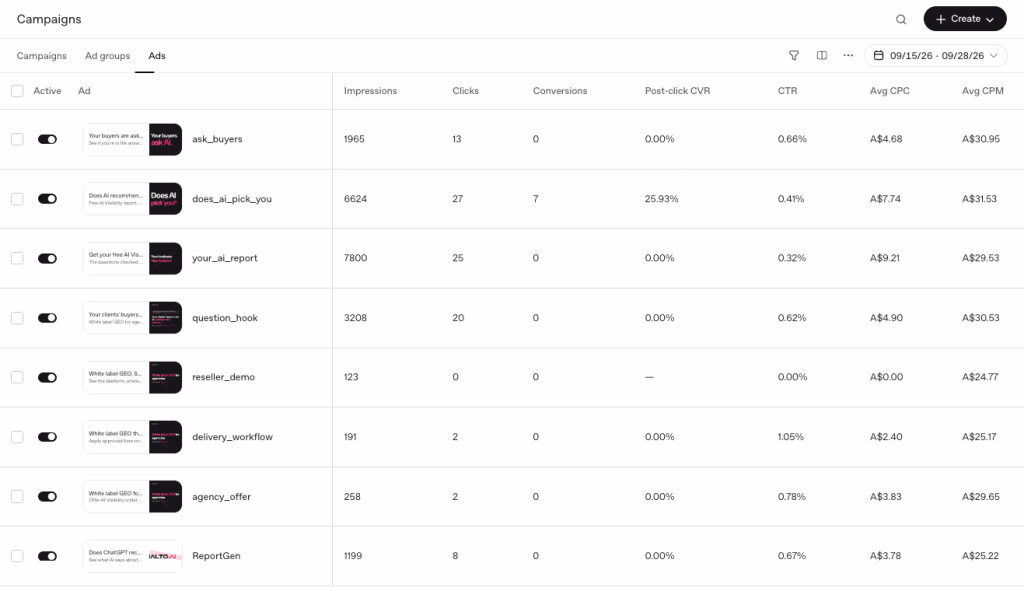
Across the whole report campaign, the ads were shown 16,389 times and drew 65 clicks, a 0.40% CTR at an average of A$7.69 a click. Once you include all three ads, those seven requests work out to a 10.8% click-to-lead rate and about A$71 a lead (see Figure 2).

The other two ads spent about A$290 between them with no reported leads.
Wright thinks the question worked because it picked up the conversation the reader was already having. “The person is mid-conversation with an AI, so a hook that continues their line of thought fits better than an interruption.” His conclusion, “A question works better than an offer.”
Both main campaigns were billed by impression, and those costs stayed fairly close. “Pricing is effectively flat CPM.” Across every ad and audience he saw roughly A$25 to A$32 per thousand impressions. The dashboard averages were A$30.51 for the report campaign and A$30.01 for the agency campaign.
At similar impression costs, more clicks bring down the average cost per click. For Wright, the gap from about A$4.70 to about A$9.20 a click “came almost entirely from creative.” But cheaper clicks didn’t necessarily help. The ad labelled ask_buyers cost just A$4.68 per click, yet Wright reported no leads from its 13 clicks.
The agency offer attracted more clicks relative to its exposure, with 24 clicks from about 3,800 impressions. Its 0.63% CTR beat the report campaign’s 0.40%, and clicks were cheaper at A$4.73 each. Even so, the roughly A$114 spent on it brought in no demo bookings.
He calls it “real interest paired with the wrong ask for a first touch.” A sample report could be the next test. “Delivery picks a winner fast.” In the agency campaign, one ad took around 85% of impressions within three days, and he “had to watch closely to make sure the variants got a fair test.” The ad, labelled question_hook, received 3,208 of the campaign’s 3,780 impressions. It belonged to the agency campaign, so it wasn’t the ad that brought in the seven report requests.
Because OpenAI chooses ads based on expected relevance and outcomes, it doesn’t promise to show each version equally often. Wright could compare the results, but he couldn’t control which visitors saw each version.
How ChatGPT ads work, inside OpenAI’s ad system
ChatGPT ads are labelled sponsored cards that appear below an answer. You supply the ad and context hints, then OpenAI chooses where to show it.
Each ad has an advertiser name, a logo, a headline, a line of description, an image and a landing page, according to OpenAI’s advertiser guide. Ads show on the Free and Go plans. Plus, Pro, Business, Enterprise and Edu accounts see none, and neither do accounts identified as belonging to under 18s. OpenAI’s Help Center says, “Ads do not influence ChatGPT’s answers.”
To choose an ad, the system looks at the context and intent of the conversation, the ad’s landing page, headline and copy, and the context hints the advertiser wrote. Advertisers can also add context hints for each ad group. These are short notes explaining the product, who it helps and when it might be useful. OpenAI says they guide matching, but writing a hint doesn’t guarantee your ad will appear in that kind of conversation. If a user has ad personalisation switched on, signals from their wider ChatGPT use can count as well.
When several ads qualify, OpenAI uses a relevance-weighted, second-price auction. The bid is one of several signals the system uses. The dashboard shows impressions, clicks, spend, CTR, average cost per click (CPC), cost per thousand impressions (CPM) and conversions. Advertisers see these totals, not the conversations behind them. Click and impression counts refresh about every 15 minutes; spend can take seven to eight hours to catch up. Advertisers can pay by impression or valid click, with a maximum bid for each ad group.
To track conversions, advertisers send events through the OpenAI Pixel or Conversions API, which OpenAI then matches to eligible ad clicks within an attribution window. OpenAI says reported totals modelled conversions where available, meaning some results are estimated. Its totals can differ from the advertiser’s records, as the Proper Cloth test showed when its dashboards disagreed. Attribution rules also change what counts as a conversion.
OpenAI calls ChatGPT Ads a beta. Ad testing, the pilot ran through April, and self-serve access has since opened in countries that include Australia. The company says changes to its delivery systems and models can make delivery and spend fluctuate, and that the platform has no established performance benchmarks. There is no reliable average against which to judge Wright’s A$71 cost per lead.
Seven leads, with customers still unconfirmed
| Claim | Evidence |
|---|---|
| The dashboard figures by ad, impressions, clicks, CTR, CPC and seven conversions | Reported by Wright from his account, unaudited |
| About A$30 and A$71 a lead, and roughly A$290 spent on ads that produced no leads | Our calculations from his figures |
| All seven requests were attributed to the question ad | Reported by Wright in one campaign |
| Why the question ad won, whether it repeats at scale, whether any lead becomes a customer | Not shown |
The pilot complicates the picture a little. Its headline began “Does ChatGPT rec…”, so it also opened with a question, but nobody requested a report after those eight clicks. The pilot was billed per click and ran before the main campaigns, so the two results aren’t directly comparable.
As Wright puts it, “Seven conversions is enough to show a direction, not enough to draw firm conclusions.”
The next question is whether anyone bought after requesting a report. Wright didn’t share revenue figures, so we don’t have that answer yet. Conversions that arrive days later also need to be counted. For now, the reported result stops at the lead rather than the customer.
The next test needs better controls
- Compare a question headline with a plain offer. Keep the image, description, landing page and offer the same.
- If one variant gets very little exposure, try separate campaigns with similar budgets and check how many impressions each receives. Separate campaigns give each ad its budget, but won’t randomise who sees them.
- Send conversion events through the OpenAI Pixel or Conversions API, then compare the count with the requests that reach your inbox or form log.
- Compare qualified leads per dollar. Use CTR and CPC to help explain the differences, and once leads turn into customers, track acquisition cost by channel with our CAC Diagnostic.
- Review the first batch of leads. Track who opens the report, follows up and becomes a customer.
The next numbers to watch are how many of the seven leads become customers and the cost per qualified lead as spend rises. Our Growth Signal benchmark brings together other business experiments, their reported results and the limits of the evidence.
Methodology note. We did not independently reconcile the seven reported leads with form submissions. Background on ChatGPT ads comes from OpenAI’s Help Center articles linked in the text.
Radisson’s ChatGPT case follows discovery through a hotel-booking handoff. It also helps separate paid exposure from traffic attributed to a plugin.
ChatGPT ads FAQ
How do ChatGPT ads work?
ChatGPT ads are sponsored cards shown below an answer on the Free and Go plans. Advertisers write ads and context hints instead of bidding on keywords, and OpenAI’s system picks ads on expected relevance and outcomes. Advertisers see aggregated reports, not conversations.
How much do ChatGPT ads cost?
In Roo Wright’s test, both campaigns were billed by impression at about A$25 to A$32 per thousand impressions. His average cost per click ran from A$4.68 to A$9.21 by ad, his report campaign cost about A$71 per lead, and his best ad about A$30. OpenAI also offers valid click billing.
Do question headlines beat offers in ChatGPT ads?
In one small test, a question headline drew all seven leads while a plain free report offer drew none. But the ads differed in more than wording, and they weren’t shown equally often.
Can ChatGPT ads work for B2B?
Wright’s business-owner offer produced seven report requests. His agency campaign had a 0.63% CTR but no demo bookings.
Can advertisers pay to be recommended by ChatGPT?
OpenAI says no. Ads are separate paid placements, and its Help Center says “Ads do not influence ChatGPT’s answers.”
Spotted an error? Contact the desk. Our corrections policy explains how we handle corrections and updates.